


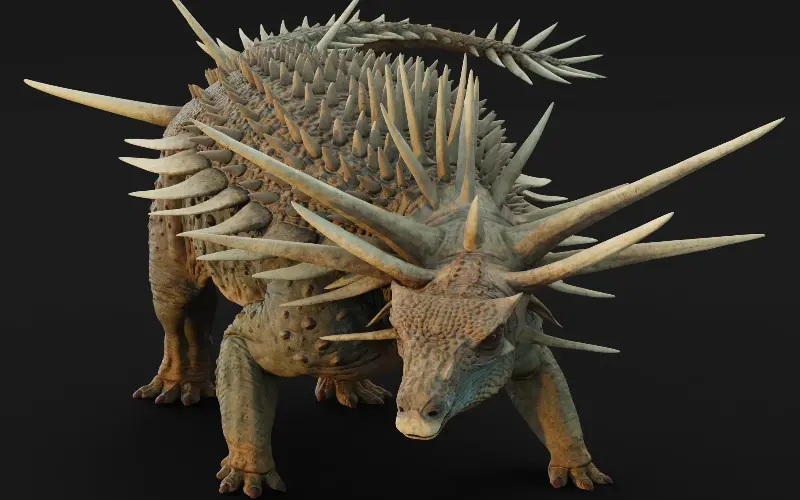
One of the world’s strangest dinosaurs is even more bizarre than first realised.
New fossils found in Morocco have revealed the armoured body of the Spicomellus was also covered in bone spikes reaching nearly a metre long.
The preserved remains also show the animal, which lived more than 165 million years ago, lost some of its armour as it evolved.
“We’ve never seen anything like this in any animal before,” said Prof Susannah Maidment of the Natural History Museum, who co-led the team of researchers.
“To find such elaborate armour changes our understanding of how these dinosaurs evolved.
“Spicomellus had a diversity of plates and spikes extending from all over its body, including metre-long neck spikes, huge upwards-projecting spikes over the hips, and a whole range of long, blade-like spikes.”
Spicomellus is a type of ankylosaur - heavily armoured herbivores which had bony skins similar to turtles, and lived from the Middle Jurassic to the Late Cretaceous period, before going extinct 66 million years ago when a comet wiped out most dinosaurs.
The creatures were four-legged, squat and under 10ft in length, leading to them sometimes being described as “walking coffee tables”.
Species usually become better at defending themselves over time, but this discovery shows ankylosaurs actually lost some of their protection, even though their environment grew more dangerous in the Cretaceous period.
“It’s particularly strange as this is the oldest known ankylosaur, so we might expect that a later species might have inherited similar features, but they haven’t,” added Prof Maidment.
The experts believe the fearsome array of spikes may actually have been used primarily for attracting mates and showing off to rivals rather than defence.
In later species, the spikes have gone, replaced by flat plates that are likely to have functioned purely for defence.
The team speculate that as larger more fearsome predators evolved, ankylosaur armour may have become simpler, less showy and more defensive, suggesting they wanted to draw less attention to themselves.
While the end of Spicomellus’ tail hasn’t been found, some of the vertebrae have been fused together suggesting it had a club or a similar tail weapon.
Spine-tingling discovery
Prof Richard Butler, project co-leader from the University of Birmingham, said: “Seeing and studying the Spicomellus fossils for the first time was spine-tingling.
“We just couldn’t believe how weird it was and how unlike any other dinosaur, or indeed any other animal we know of, alive or extinct.
“It turns much of what we thought we knew about ankylosaurs and their evolution on its head and demonstrates just how much there still is to learn about dinosaurs.”