


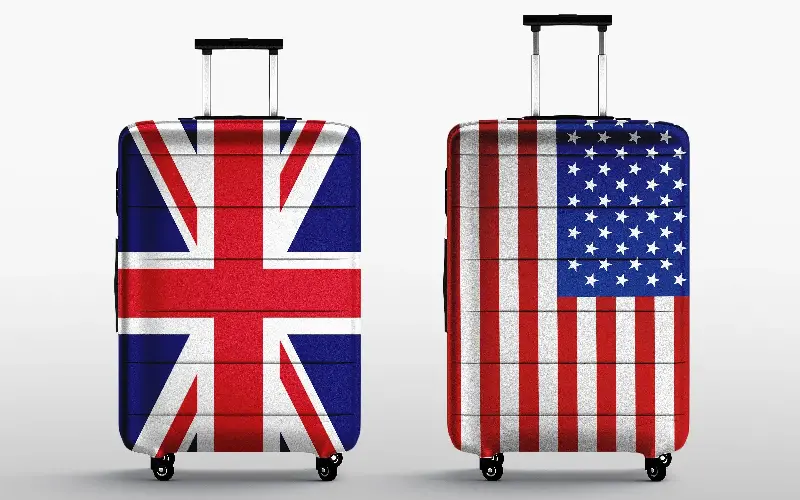
I was once reading a novel over breakfast at a high-end Caribbean hotel, where I had been staying by myself for a few days. So deeply immersed was I in the literary drama that I missed the one playing out before me: a collection of waiters had gathered, and one had been pushed forward to enquire of me: “Madam, are you British or American?”
Slightly taken aback, I asked: “Why?”
He sheepishly explained that British and American guests required entirely different treatment, and they could not quite figure out which method would suit me. “You are friendly, but you are quiet. What are you?”
In fairness, the clichés of British and American tourists are very different. Think Clark Griswold’s earnest and almost competitive desire to “bond” with his family in National Lampoon’s Vacation, versus the perpetually vexed spinster Cousin Charlotte Bartlett in A Room with a View.
Boisterous American naiveté meets grumbling British entitlement.
The waiters, who I’m convinced had placed bets on my nationality, further explained that Americans want to be checked on every five seconds (“Is your omelette good?” “Is it still good?” “Would you like another coffee?” “Would you like to tell me your entire day’s itinerary, as well as everything that little Tyler has ever thought of or done?”).
By contrast, the British, explained my new friends, largely want to be left alone. They wear louder clothing (this surprised me, but we were at a particularly high-end hotel, where the Americans tended towards a preppy Kennedy vibe, whereas the British seemed inspired by Princess Margaret in Mustique).
They also, apparently, compare everything to home, drink tea in the heat (and complain that no one knows how to make it), like rules (and want to know them), and do not wish to exchange any words about the state of their omelette.
After this brief tutorial, I did the only sensible thing and declared association with neither country, despite being Anglo-American (for there is little worse than a Briton abroad – with the notable exception of Americans).
So how do these two beasts actually behave on their summer holidays? Here’s what I’ve observed.
Money matters
Americans take fewer holidays than their British counterparts.
A Deloitte survey found that 53 per cent of Americans planned to take a holiday this year – up from 48 per cent in 2024 – though economic fears were tempering their spending, with the average travel budget for the whole year sitting at $4,606 (£3,494).
By contrast, 66 per cent of Britons expected to have a holiday this year, according to the Post Office Travel Money Holiday Spending Report. A survey by Aviva insurance put the average trip cost for Brits at £3,000.
Why is there such a difference? It is dictated in part by more meagre annual holiday leave in the States, but is also cultural: Britain sits both geographically and ideologically between the US and continental Europe, where the right to take off all of August is virtually sacrosanct.
Americans have not yet been introduced to the sweet art of doing nothing. When they do travel, particularly abroad, Americans tend to have a crowded agenda, because it may be the only time they visit.
There is more context to consider: American children tend to have longer school breaks in the summer months (just over two months vs six weeks for UK state schools). Because of this, perhaps, Americans tend to outsource childcare, and are passionate about summer camps.
These are seen as a great learning and personal growth opportunity; just over half of US kids attend them, though they aren’t cheap, and sessions are typically two, four, or even seven weeks.
An American friend recently told me that her family cannot take a family summer holiday: her two teenagers insist on attending their summer camp’s seven-week session every year; were they to stay home, their friends would all be at camp, and they would miss out.
Driven mad
Britons love to fly and flop; Americans are far more likely to drive – it’s cheaper, and there’s plenty on their doorstep (about a quarter of Americans have never travelled abroad).
I know a couple from Massachusetts who drive to Florida each year, sometimes with their children, for a bit of R&R. That’s a 1,471-mile drive (taking around 22 hours, not including stops). And this is not unusual.
According to a study by Enterprise, the car rental company, 66 per cent of Americans were planning to drive to their summer holiday, with 90 per cent planning to travel within the US for their next trip and Florida (10 per cent) and California (9 per cent) the most popular destinations.
According to an Allianz study, only 45 per cent of Britons were planning a staycation in summer 2025. There’s a logical explanation, of course. Britain is tiny, and Britons want sun (for which there are cheap packages to Marbella).
Bad behaviour
People on both sides of the Atlantic are drawn to the water, whether it be a lakeside or a seaside. But their behaviour once there varies. Britons are happy to huddle on the beach in all weather (taking a windbreak and flask of tea if they’re still in Blighty).
Americans bring everything but the kitchen sink (everyone has a chair, which they sit in under massive tents; there are coolers larger than some dining tables, filled with enough food for an army; the adults bring 2L thermoses of iced coffee, per person).
And while Britons have a justifiably terrible reputation in Spain, Greece and lots of other places for loud, public inebriation, young Americans display similar behaviour from Miami to Mexico.
Cultural and adventure holidays are also popular with both Britons and Americans, particularly with those on bigger budgets: Sri Lanka, safaris – all are up for discussion if you have the budget.
Language barriers
Neither the British nor the American tourist is, generally, adept at speaking any language other than English.
But there is a key behavioural difference: I once went to Paris with an American who thought his Louisiana Creole would pass muster with the French. When he discovered that it did not, he politely retreated to the sad world of hand gestures and sheepishly mumbled English.
In the matter of language, the Americans tend to start optimistic, but quickly grow apologetic and admit defeat. Britons, on the other hand, trot out their schoolboy French and simply speak in increasingly loud volume when they are not understood.
Child’s play
American parents seem more willing to travel without their children – and small wonder. If those small people are there, these parents are employed in a non-stop narration of this fabulous Learning Experience.
British parents embrace the family holiday as a time to be in the same place as their children, but the goal is often to be pursuing separate activities.
Both nationalities are equally keen to bring the grandparents – it means free on-site childcare, after all.
Pet peeves
Americans cannot tolerate a lack of temperature control: they like their hotel room at 18C and expect to be able to set it to that. If this is not possible, they will let you and everyone else know immediately.
The British cannot stand to be left out or overlooked. Why was their group on the cruise divided among tables, when another was not? Why were they not upgraded when the couple before them were? But the British will never complain. They will just seethe for the duration of the holiday.
Making a scene
Britons abroad want, largely, to continue on their own programme, undisturbed.
The actor Minnie Driver recounted last week that she’d been spending a week by herself on a beach near Rome. “I swam for 1.5 miles until a lifeguard in a pedalo arrived to ask me if I was OK,” she wrote in the caption to her Instagram post.
“Something seemed to make sense to him when I told him I was British.” Driver seems to have relished her low profile; contrast that with Lauren Sanchez, another 55-year-old woman who had an Italian holiday earlier this summer and brought Venice to a standstill.