


Life – we are often told – is about connections. Whom you know, how well you know them – but also, how closely you yourself are linked to the hub of it all, the centre of the action.
This, loosely, helps to explain one of tourism’s big questions: why is one set of Atlantic islands so popular with holidaymakers, while the other is still a relatively niche choice?
The dichotomy is there, starkly, in the numbers. On average, Spain’s Canary Islands greet 16 million tourists per annum, 5.6 million of whom head to the biggest of the eight outcrops, Tenerife. By contrast, Portugal’s largest archipelago, the Azores, says hello to a “mere” 1.2 million visitors every year – in total.
Why the statistical gulf? For three reasons.
The first is location. Simply, the Azores are more remote than the Canaries. Unlike their more feted Portuguese sibling Madeira (which sits “near” Tenerife; 260 miles north of it), they are close to being “mid-Atlantic” – marooned so far into the swells that they lie 870 miles west of Lisbon, and “only” 1,200 miles south east of Canada (Newfoundland).
The second is climate. These nine isles are significantly more northerly than the Canaries, strewn between the latitudes of 36N and 39N – whereas Tenerife et al lurk between 27N and 29N. The shortfall in temperature is not huge – a calendar average of 16-25C in the Azores, as against 18-26C in the Canaries – but the weather in the former is less reliable; prone to the mood swings which come into existence halfway across a vast ocean.
The third reason is a consequence of the first two: a relative lack of connections. Whereas Spain’s sunny satellites are famous winter hot spots, with countless flights landing every day, the Azores are far less disturbed by the roar of jet engines. It isn’t hard to reach them – but the easy convenience of a package trip to, say, Lanzarote, is not so readily available.
Instead, the Azores are a destination wrapped in mystery. Before Columbus went west in 1492, the archipelago was – for Europeans, at least – the end of the world. Five centuries later, the islands still resemble the lip of a precipice – lava-borne peaks rising from blue depths, whales and dolphins breaching at their feet.
You will not feel disconnected if you visit the Azores – whether for their history, wildlife, volcanic geography, or even their less-remarked-upon beaches. But you will feel that you have embarked upon a journey…
Where to go
Each of the nine Azorean islands is the product of seismic activity at a point where three tectonic plates (the Eurasian, the African and the North American) rub shoulders. Somewhat appropriately, this has resulted in three distinct clusters of islands – with sizeable stretches of water between them; 370 miles distinguish the easternmost member of the club, Santa Maria, from the westernmost, Flores. Such distance means that many tourists base their getaways in one of the groups, or limit their itinerary to two of the three – although visiting the complete set in a single holiday, while quite the endeavour, is not impossible.
The Eastern Group
Realistically, São Miguel should be the initial stop on your Azorean timetable. Not only is it the largest of the nine islands, a loosely croissant-shaped outcrop of 293 square miles; it has the main international airport (see “how to get there”) and the biggest “city”.
Pitched towards the west end of the south coast, Ponta Delgada is as close as the Azores come to “urban life”; more than a quarter (67,287) of the archipelago’s entire population (236,440) calls it home. But it rarely feels crowded. Rather than gritty cacophony, you are more likely to notice the thick slabs of heritage that have accumulated in the six centuries since Portugal began the process of settlement (in 1433).
Prior to this, these volcanic outposts were vaguely known to cartographers, but were uninhabited. The waterfront is a miniature Lisbon – in the classic Portuguese mosaic pavements (of black basalt and white limestone) on the Praça de Gonçalo Velho, the three arches of the 18th-century city gates at the square’s northern end, the 16th-century Church of São Sebastião behind. Just down the shore, the Forte de São Brás (also 16th century) still watches out for Spanish galleons.
There are restaurants galore in the surrounding streets – including Restaurante Nacional, which does a nice line in fresh seafood. And hotels too. The four-star Hotel Marina Atlantico (00351 296 307900) offers a downtown location, a swimming pool, and double rooms for £66, with breakfast.
Public transport on São Miguel is limited, but it is worth hiring a car to explore farther. Out in the east of the island, the aptly named small town of Furnas makes a spectacle of the fire beneath the topsoil – via steaming fumaroles (volcanic gas vents) and the insistent smell of sulphur. You can take the waters safely via hot springs such as Poça da Dona Beija (90-minute bathing sessions for €8), and also make a feast of the experience. Several local restaurants, such as Miroma, serve cozido das caldeiras, slow-cooked stews of meat and vegetables where the metal pot is buried in the scorching ground for six (or so) hours.
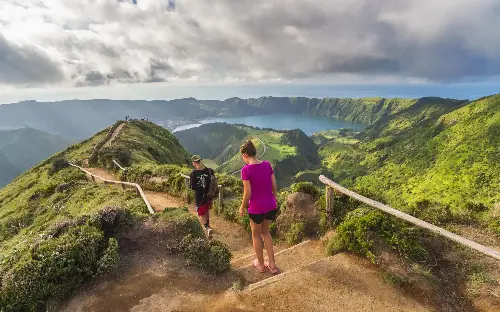
Out at the west end of São Miguel, meanwhile, the Lagoa das Sete Cidades (Lagoon of the Seven Cities) is a case of volcanic beauty in excelsis: a geological curiosity that sees two distinct lakes – one of green liquid, one of blue-black – co-exist in the same caldera.
São Miguel is not revered for its beaches (suffering from the grey rockiness particular to volcanic islands), but the four-star Pestana Bahia Praia Beach Resort (00351 296 539130; doubles from £120) occupies a lovely spot, midway along the south coast, at Agua de Alto. A seven-night stay here, flying out of Manchester on November 16, starts at £549 per person, through Love Holidays (01234 230 440).
Everything on São Miguel is eclipsed – in age, at least – by Santa Maria, which was the first Azorean island to rise from the sea bed, some eight million years ago. Hidden over the horizon, 62 miles south of its neighbour, this little nugget of just 37 square miles does have sandy edges – notably Praia Formosa, on its south flank. Just above it, Villa Natura (00351 962345 999) is a bijou three-bedroom rental property. It can be hired at full capacity (six people) for the week starting November 2, from €2,170 (£1,796).
The Central Group
Home to the busy Lajes Airport, Terceira is the likeliest arrival point for tourists visiting the close-clustered Central Group of five islands. Its name works on two levels. Not only is it the third-biggest piece of the Azorean jigsaw, but it was the third to be discovered (the official reason for its title) – either in 1439, or in 1445. Whatever the year, it soon had a functioning port. Angra do Heroísmo, on its south coast, was quick to become a haven for Portuguese ships. Like Ponta Delgada, it shows off its heritage brazenly. The Forte de São João Baptista – on the west side of the harbour – was bristling with cannons by 1567.
But Angra is more than a museum, and you can easily spend a weekend in its company – shopping for gourmet morsels at the Mercado Duque de Bragança, admiring the Catedral de São Salvador (1570 at root, though partly rebuilt after an earthquake in 1980), strolling along the flower-framed pathways of the Jardim Duque da Terceira, and pausing for drinks at promenade bar O Pirata. The five-star Angra Marina Hotel (00351 295 204700) has a spa – and rooms from £72.
You can hike towards Terceira’s summit – the 3,350ft (1,021m) Serra de Santa Bárbara – on trail PRC03 TER, from the westerly village of Serreta. But if you are keen to clamber into the clouds, there is a more obvious challenge immediately at hand. Pico makes no attempt to dissemble (the word literally translates as “peak”). At 7,713ft (2,351m), the splendidly conical stratovolcano which dominates the island is not only the highest mountain in the Central Group – it is the highest in the Azores, and in Portugal as a whole.
In spite of this, an ascent does not require technical skill. It can be conquered, via a spot of scrambling at the very top, by anybody with reasonable fitness and a head for heights. And the views, if the weather is co-operating, are incomparable. Local operator Tripix offers escorted day-climbs from €65 per person.
The volcano is just as spectacular when seen from ground level, not least from the south coast. Here, the Museu dos Baleeiros, in Lajes do Pico, remembers the whaling industry, which provided the island’s main mode of employment until as late as 1986. Just up the shoreline, the lovely four-star Aldeia da Fonte hotel (00351 292 679500) in Silveira has double rooms from £71 per night.
Although it appears to be an Atlantic dragon, the mountain is in no mood to belch fire; it has been dormant since 1720. If you want evidence of the forces – destructive and creative in the same breath – which underpin the archipelago, you have to make the short hop west, to Faial. Pico’s smaller neighbour has felt the heat of eruption in the recent past – its Capelinhos volcano opened its mouth in September 1957, and did not cease the fire and fury until October 1958.
The outpouring left behind an oceanic Pompeii – extensive excavation was needed to retrieve the lower levels of the lighthouse at the isle’s west tip from a tomb of ash. Now, the site operates as a museum, and makes for a striking contrast to the pretty capital, Horta – where you can hunker down in the Pousada Forte da Horta (00351 292 242060). Here, another sturdy 16th-century stronghold has been repurposed as accommodation. Double rooms for €110.
The last two members of the Central Group are more removed from what is only a faintly beaten path. Both reward the effort to reach them. Tiny Graciosa continues the magma-fried theme. You can wander down into the main caldera – and into the Furna do Enxofre, a lava-cave in the belly of the beast. São Jorge is just as dramatic, the Caldeira do Santo Cristo lagoon, on its north coast, defying the ocean whose tides pound its outer walls of rock. You can swim in this most eerie of pools via the Three Island Tour sold by Artisan Travel (01670 785085) – an 11-day group holiday that also visits Faial and Pico. From £1,545 per person, flights extra.
The Western Group
The final two slivers of Azorean soil are misty outliers, concealed in the distance – 170 miles separate Flores from the westernmost island of the Central Group, Faial. As such, they tend to be the last hurrahs for travellers to the Azores. They are the terminal stations that you might save for your second or even third holiday; geographical full stops where, politically speaking, Europe reaches its limit. The next landfall going west is New Jersey.
All the same, this tiny double act has its charms. Flores takes its job as the edge of a continent seriously; the 20 waterfalls which decorate its west coast, plunging down sheer cliffs between Faja Grande and Fajazinha, seem dramatically conclusive. And Corvo might well be the end of the world; a place of farmland, solitude and just 384 inhabitants.
Realistically, a fully packaged trip is the best way to venture this far west. A seven-night dash to the aptly named Hotel Ocidental on Flores, flying from Stansted (via São Miguel) on November 2, costs from £1,344 per person with Sunvil (020 8758 4722).
How to get there (and around)
At the turn of the century, air routes to the Azores were limited. Nowadays, while the options are not endless, travellers have choices – including British travellers, who can pick from three direct services. All three land at Ponta Delgada on São Miguel – Azores Airlines, from Gatwick; British Airways from Heathrow; Ryanair from Stansted.
Ryanair also flies to Ponta Delgada from Lisbon. As does Portugal’s national carrier, TAP. Additionally, these two airlines compete in sending direct planes from Lisbon to Lajes Airport on Terceira – the aviation hub for the Central Group.
Once you have touched down on São Miguel or Terceira, island-hopping is easy. Azores Airlines’ local partner, Sata Air Açores (also Azores Airlines), serves each of the other islands from São Miguel – and seven of the eight (all except Santa Maria) from Terceira.
The close-knittedness of the Central Group makes the ferry another – crucial – component of the travel infrastructure. The main operator, Atlantico Line, offers six routes, colour-coded in the style of Tube lines. Five of them (blue, green, white, purple, orange) link the five islands via various combinations of ports. The shortest possible sailing (Madalena on Pico to Horta on Faial – five miles via the Linha Azul/blue line) costs €3.80 one way; single fares for the longest (Horta to Praia da Vitória on Terceira – 110 miles via the Linha Branca/white line) start at €29.50.
In addition, the Linha Rosa (pink line) links the Western Group duo of Flores and Corvo. However, at time of writing, there is no ferry between Eastern Group twosome São Miguel and Santa Maria. While there have been summer services in the past, the distance between the two isles is impractical – particularly when the flight only takes 30 minutes.
What to book
Wildlife
The Azores’ mid-oceanic location famously lends itself to cetacean encounters. Sperm whales and Atlantic dolphins are commonly visible around the islands, and possibilities for excursions with cameras and binoculars are plentiful (in total, 28 whale and dolphin species are present in Azorean waters, and sightings occur year-round).
Local specialist Futurismo has bases on both the south (Ponta Delgada) and north coasts (Rabo de Peixe) of São Miguel, as well as in Lajes do Pico, and runs whale-watching trips from each of them (half-day tours from €65 per person). Ocean Emotion provides an identical service out of Angra do Heroísmo on Terceira (also from €65).
If you want to admire these creatures of the deep with absolute focus, Naturetrek (01962 733 051) sells an eight-day escorted tour, Whales and Dolphins of the Azores, which keeps its eye on the waves around Pico. From £2,495 per person, including flights. The next departure is slated for June 30 2025 (private trips can also be arranged).
Active
With so many peaks and troughs, the Azores are an ideal playground for those who like their downtime to come with a few ups. Explore (01252 240 637) offers a regular Walking in the Azores group tour which charts four of the islands, on foot, over the course of 14 days. The itinerary takes in São Miguel (the Sete Cidades crater, Furnas), São Jorge (the Caldeira de Santo Cristo lake and the Faja dos Cubres), Pico (the volcanic landmarks of the south coast) and Faial (the Capelinhos lighthouse and museum). Ten editions of the trip are scheduled for 2025, from £2,399 per person (not including flights).
Alternatively, Headwater (01606 218 851) offers a self-guided Azores Cycling holiday that involves a full loop of Terceira over the course of a week. From £1,299 per person, including airport and bag transfers, as well as bike hire (flights extra).
Road trip
A much-scattered archipelago is not an obvious place for a holiday that involves days behind the wheel, but Trailfinders (020 7084 6500) manages to square this particular circle with a São Miguel Encompassed break. The biggest of the Azores is (just about) big enough to sustain a week of road-tripping, and this eight-day package allows for exploration in full. From £995 per person – including rental car (flights extra).
Wine
Wind-swept islands where salt billows on the breeze do not sound like the perfect environment for viticulture, but the Azores has a surprisingly resilient wine industry. Production is especially evident on Terceira, Pico, Graciosa and São Miguel, where arinto, boal, fernão pires, terrantez and verdelho grapes find shelter behind low stone walls. Winerist (020 7096 1006) takes to the latter island with its Azores Food and Wine Getaway, a private five-day tour. From €1,895 per person (flights extra).
The ‘full thing’
If you want to take in a broad cross-section of the archipelago, the Grand Tour of the Azores sold by Regent Holidays (0117 453 0059) should suffice. This 15-day getaway ticks off all three of the island groups, and five of the nine islands (São Miguel, Flores, Faial, Pico and Terceira). From £3,185 per person, including flights.
Pampering
The Azores are rarely sold as a fly-and-flop destination, but if all you want is a week of indolence, plus the odd spa treatment, such idle dreams are also feasible. A seven-night stay at the four-star Terra Nostra Garden Hotel, amid the hot earth of Furnas on São Miguel, starts at £1,840 per person, with flights, via Kuoni (0800 088 5724).
Family
Similarly, the archipelago never features too highly on lists of the best travel hotspots for children. Nonetheless, with bubbling hot springs and breaching whales, there is plenty to entertain younger visitors. Azores Choice (01768 721020) plays on both with its eight-day São Miguel Family Holiday – from £1,800 a head, with flights.
On a budget
As with anywhere in Europe, the book-end months are colder in the Azores, but cheaper. A week’s stay at the four-star Talisman Hotel in Ponta Delgada, flying from Heathrow on December 7, starts at £531 a head via British Airways Holidays.