



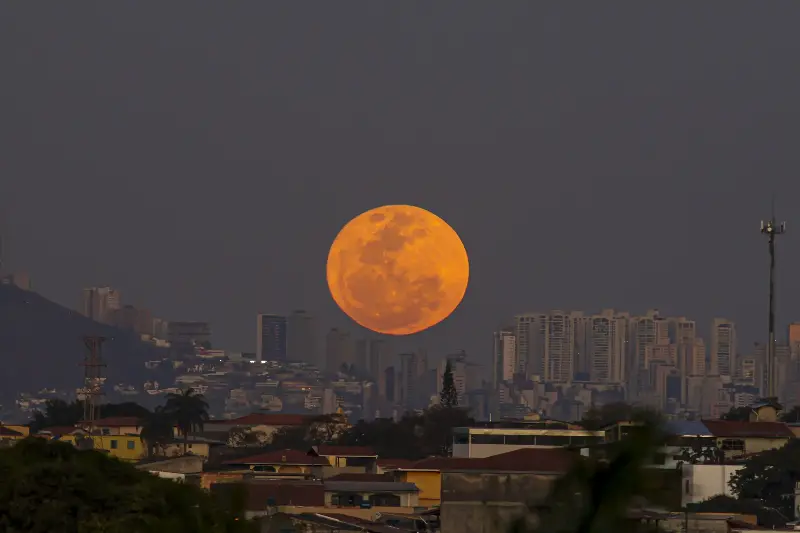
The night sky will offer a dazzling celestial display over the weekend as the Sturgeon Moon rises. Here's how to catch it at its brightest.
Reaching its peak illumination at 3:55 a.m. EDT on August 9 the Sturgeon Moon will be best visible at dusk. For the best view, look up at the sky on the evening of Friday, August 8.
August's full moon is named after the sturgeon, North America's biggest freshwater fish, which appears in large numbers at this time of the year.
It's also known as the Green Corn Moon, Grain Moon and Red Moon, the latter referring to the reddish tint it can take on in the hazy summer atmosphere.
The Sturgeon Moon will appear in the constellation Aquarius and won't rise very high above the horizon. This gives the opportunity to see the "Moon illusion"—a visual effect that makes the moon look unusually large, even though it isn't.
Where to See the Sturgeon Moon
The Sturgeon Moon is best seen from an elevated location, like an open field or an east-facing coastline with a clear view of the eastern horizon.
While the naked eye works for this annual lunar event, binoculars or a small telescope can offer a much better view.
Don't worry if you're not able to catch it on Saturday, the Sturgeon Moon will look full the night before, and the night after.
The ideal time to view it depends on where you are. In New York, the moon will rise at 8:03 p.m. ET on August 8 and at 8:32 p.m. ET on August 9. In Los Angeles, moonrise will occur at 7:48 p.m. PT on August 8 and at 8:21 p.m. PT on August 9.
On the night of August 9, New York City is currently expected to have clear skies all along, same goes for Los Angeles and Phoenix.
When Is the Next Full Moon?
After the Sturgeon Moon on August 9, 2025, the next full moon will be the Corn Moon, visible on September 7, 2025.
September's Full Moon gets its name from the time of year when crops are traditionally harvested at the end of summer. D
uring this period, the Moon shines especially brightly and rises early in the evening, giving farmers extra light to work into the night. It's also known as the Barley Moon.
Do you have a tip on a science story that Newsweek should be covering? Do you have a question about the Moon? Let us know via [email protected].