


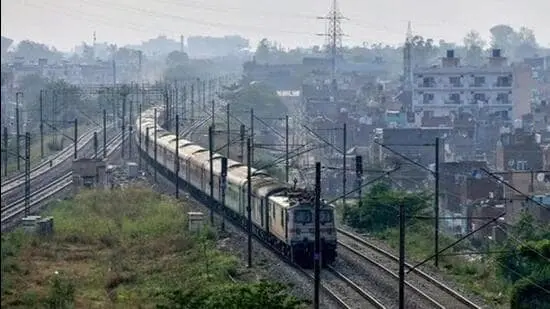
New Delhi: The union cabinet chaired by Prime Minister Narendra Modi on Tuesday approved four major projects of the ministry of railways worth a total of ₹12,328 crore, aimed at boosting passenger convenience, freight movement and regional connectivity while supporting India’s green and sustainable growth goals.
One of the crucial proposals cleared is the Deshalpar-Hajipir-Luna and Vayor-Lakhpat new line project in Gujarat. With an estimated investment of ₹2,526 crore, the new alignment will add 145 route kilometres and 164 track kilometres to the state’s railway network. Planned for completion within three years, the line will extend vital connectivity to the far flung Kutch region, aiding in the transportation of salt, cement, coal, clinker and bentonite.
The government highlighted the strategic importance of the project as it will connect the Rann of Kutch, while also promoting tourism by bringing destinations such as the Harappan site Dholavira, Koteshwar temple, Narayan Sarovar and Lakhpat fort onto the railway map. Thirteen new stations will be built under this project, directly benefiting 866 villages and about 16 lakh people.
Alongside the Gujarat initiative, the Cabinet approved three multi-tracking projects in different parts of the country. These include the 173-kilometre Secunderabad (Sanathnagar)-Wadi third and fourth line, spanning Karnataka and Telangana at a cost of ₹5,012 crore; the 53-kilometre Bhagalpur-Jamalpur third line in Bihar at a cost of Rs. 1,156 crore; and the 194-kilometre Furkating- New Tinsukia doubling in Assam at a cost of Rs. 3,634 crore. The timelines for completion range between three to five years.
Collectively, the government said, these projects are expected to enhance connectivity for over 3,100 villages, benefitting around 47.34 lakh people, including those in the aspirational district of Kalaburagi in Karnataka.
“These projects will ensure seamless and faster transportation of both passengers and goods. They will improve connectivity and travel convenience besides reducing logistic costs and dependence on oil imports,” the government said in a statement. It added that the initiatives will help lower carbon emissions and generate about 251 lakh human-days of employment during the construction phase.
According to the government, the expanded line capacity will significantly reduce congestion on busy routes, improve operational efficiency and service reliability, and enable additional freight traffic of about 68 million tonnes per annum. The work will also facilitate the smoother movement of key commodities such as coal, cement, clinker, steel, containers, fertilisers, petroleum products and agricultural goods, thereby strengthening supply chains and supporting economic growth.
Moreover, the government estimates that the projects will reduce oil imports by about 56 crore litres and cut carbon dioxide emissions by 360 crore kilograms, equivalent to planting 14 crore trees. “The Railways being an environment-friendly and energy-efficient mode of transportation will help both in achieving climate goals and minimising logistics cost of the country,” the Cabinet note said.
Planned under the PM Gati Shakti National Master Plan, the four projects together will add around 565 kilometres to the Indian Railways (IR) network, covering 13 districts across Gujarat, Karnataka, Telangana, Bihar and Assam.
The government emphasised that the initiatives reflect PM Modi’s vision of building a self-reliant or Atmanirbhar India.
“These projects are in line with the vision of New India, which will make the people of the region Atmanirbhar by way of comprehensive development in the area and enhance their employment and self-employment opportunities,” it said.